
What Are Peptides? The Complete Guide to Peptides in Skincare


Area
Key Takeaways
- Peptides are skin building blocks: They are short chains of amino acids that signal cells to support collagen and elastin production.
- Not all peptides act the same: They fall into four distinct categories, each with a different mechanism for supporting skin health.
- Clinical evidence is solid but specific: Ingredients like Matrixyl and Argireline have peer-reviewed support, but formulation quality matters.
- Consistency is the secret. Peptides are “slow-burn” ingredients that require daily use over several months to show real, lasting results.
You’ve probably seen peptides listed on the back of dozens of product labels recently, or all over your social media feed. They appear in everything from high-end serums to everyday moisturisers, often accompanied by big promises.
So, do these ingredients actually do anything for your skin? The marketing can be confusing, and it’s difficult to know what’s science and what’s just hype.
This guide shares the reality of peptides, including the different types and what the evidence actually says. You’ll learn how to identify them on a label and how to fit them into your routine. Making better skincare choices starts with understanding the basics.
What are peptides in skincare?
Think of peptides as short chains of amino acids, which are the building blocks of proteins. If you imagine proteins as long, complex strings of beads, peptides are just the shorter segments. Your skin relies on collagen and elastin for firmness and bounce, but as we age, our natural production of these proteins slows down.
This is where topical peptides enter the picture. They act as messengers, signalling your cells to produce more collagen, support structural repair, or soften the muscle movements that cause expression lines. It works with your skin’s natural biology rather than against it. Since there are hundreds of different peptides and they don’t all do the same thing, grouping them into specific categories makes choosing the right product much easier.
What are the different types of peptides and what do they do?
This classification system helps you match a product to your skin’s specific needs. According to a 2025 peer-reviewed study published in Biomolecules, we can group most skincare peptides into four main categories.
Signal peptides
- They mimic your skin’s natural signals to tell fibroblast cells to produce more collagen and elastin.
- Palmitoyl Pentapeptide-4 (Matrixyl) is the most studied example, with a 12-week trial showing improvements in skin texture.
- Look for ingredients ending in “peptide” or starting with “palmitoyl” on your product label.
Carrier peptides
- These act as a delivery system, transporting trace elements like copper into the skin to support collagen synthesis.
- Copper Peptide (GHK-Cu) is the most researched option, helping with skin repair and reducing inflammation.
- They are a useful addition to your routine, but avoid viewing them as a magic bullet solution for every skin concern.
Neurotransmitter inhibitor peptides
- These act as a topical alternative to cosmetic injections by helping to relax the muscles that cause expression lines.
- Argireline (Acetyl Hexapeptide-3) is the most well-known example and has shown significant anti-wrinkle efficacy in trials.
- The results are more subtle than a clinical procedure, but they help soften dynamic lines with regular, consistent use.
Enzyme inhibitor peptides
- These work by blocking the specific enzymes that naturally break down your existing collagen.
- Common ingredients often include those derived from soybean, silk, and rice proteins.
- While the research is promising, these are currently at an earlier stage of study compared to other peptide types.
Do peptides in skincare actually work?
Yes, they do, though clinical evidence varies depending on the specific peptide. While well-studied options like Matrixyl and Argireline have solid data, results often depend on the quality of your product’s formula.
If you’re wondering what peptides do for skin, they offer tangible benefits with consistent use.
- Support collagen production: With daily use over time, peptides for skin can help maintain skin firmness and elasticity.
- Reduce fine lines: Ingredients like neurotransmitter inhibitors can help soften expression lines.
- Support the skin barrier: By providing building blocks for proteins, they help your skin stay resilient against environmental stress.
Don’t expect the same dramatic, instant results you’d get from clinical procedures. The base formula matters just as much as the peptide itself. A well-formulated mix containing Hyaluronic Acid, Ceramides, and Vitamin E will always outperform a single peptide in a poor base. Consistency is essential. Peptides are “slow-burn” ingredients that reward a daily routine rather than occasional use.
What’s the difference between peptides and collagen peptides?
It’s easy to confuse these two, but they play completely different roles in your skincare routine.
- What they are: Collagen peptides are fragments derived from breaking down larger collagen proteins.
- How they function: Full-sized collagen molecules are too large to penetrate the skin, so hydrolysed collagen doesn’t actually rebuild your own collagen.
- The hydrating benefit: Instead, they act as a humectant that draws moisture into the skin, which plumps your complexion and softens the look of fine lines.
- Oral vs topical: Oral collagen supplements are a separate topic with mixed evidence, so it’s best to speak with a healthcare professional if you’re curious about them.
While they aren’t the same as the signal peptides that stimulate new collagen, they remain an excellent moisturising agent for healthy, plump-looking skin.
What should you look for in a peptide skincare product?
When choosing the best peptides for skin, focus on how the formula is built.
Format is key
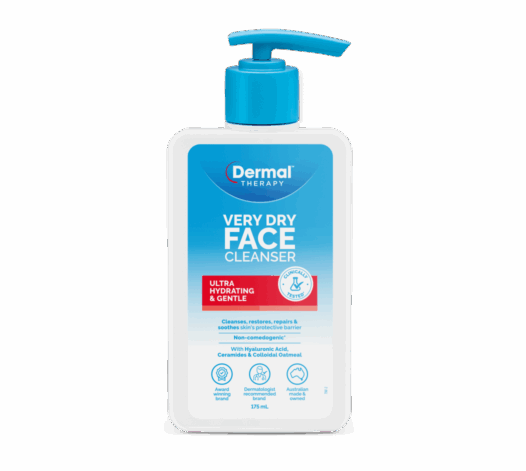
Peptides need time to work, so they’re best in leave-on serums and creams. Don’t waste your money on peptide cleansers that get rinsed away immediately.
Packaging matters
These ingredients are delicate and break down when exposed to light or air. Always choose pump dispensers or airtight tubes to keep your formula stable.
Look for supporting ingredients
Peptides perform best when they have backup. Look for formulas that combine peptides with Hyaluronic Acid, Ceramides, and Antioxidants. This creates a more robust treatment than a single-peptide formula.
Identify them on the label
Most names end in “peptide” or start with “palmitoyl.” Just keep in mind that some ingredients, like glutathione and carnosine, are also peptides even if the name isn’t obvious.
We recommend Dermal Therapy Overnight Face Repair Cream. This product is made in Australia and available at Chemist Warehouse and Priceline. It combines peptides with Hyaluronic Acid and Ceramides in a leave-on format where these ingredients can truly work.
How do you add peptides to your skincare routine?
Adding peptides to your skincare routine is straightforward, as they play nicely with most products and skin types.
- Layer them correctly: Apply your peptide products after cleansing and any light, water-based serums but before your thicker moisturisers or oils.
- Watch your acid timing: Strong acids like AHAs, BHAs, or high-strength Vitamin C can break down peptides. It’s best to use those in a separate morning or evening routine rather than layering them together.
- Be patient: Peptides aren’t fast-acting. Most clinical studies track results over eight to twelve weeks, so don’t worry if you don’t see changes in the first fortnight. Just keep going.
- Keep it simple: You don’t need to use every type of peptide at once. A single, well-formulated product that combines signal peptides with supporting actives is more effective than layering multiple items.
Conclusion: Supporting your skin with the right ingredients
Peptides are a genuinely useful and well-researched category of skincare ingredients. Like any tool, they work best as part of a consistent, well-formulated routine rather than as a standalone fix.
If you’re ready to add a clinically backed ingredient to your routine, our Overnight Face Repair Cream is a good place to start. It contains two signal peptides, Hexapeptide-9 and Palmitoyl Tripeptide-5, alongside Hyaluronic Acid, Ceramides and Urea, in a leave-on overnight format that gives these ingredients the contact time they need to work.
You can also visit our Knowledge Hub for more advice on building a skincare routine for long-term skin health.
FAQs
References:
- Pintea A, et al. Peptides: Emerging Candidates for the Prevention and Treatment of Skin Senescence. Biomolecules.
- Wang Y, et al. The anti-wrinkle efficacy of Argireline. American Journal of Clinical Dermatology.
- Robinson LR, et al. Topical palmitoyl pentapeptide. Journal of Cosmetic Science.